|< C++ String Class 2 | Main | C++ String Class 4 >|Site Index |Download |
MODULE 25a
C++ STRING CLASS PROGRAMMING 3
My Training Period: xx hours
This is a continuation from the previous Module, compiled usingVisual C++ 6.0 with SP6 and Visual C++ .Net. g++ (GNU C++ run on my Fedora 3 machine) example is given at the end of this Module. The source code for this tutorial is available atC++ Characters & Strings source codes. Take note also for the codes that span more than one line, which they are not supposed to.
The C++ string and character programming abilities that should be acquired:
-
More working program examples of C++ string and character template class member functions.
-
Able to understand and use thebasic_string template class.
-
Able to recognize the Containers, Iterators and Algorithms constructs.
What do we have in this session?
assign() example
at() example
The basic_string::basic_string
basic_string<>
begin() example
c_str() example
capacity() example
clear() example
compare() example
copy() example
|
| assign()
// assign(), string assignment #include <string> #include <iostream> using namespace std;
int main() { // assigning the characters of a C-string to a string string str1; const char *str2 = "StRiNg assign()";
cout<<"str2, C string is: "<<str2<<endl; str1.assign(str2); cout<<"Operation: str1.assign(str2)"<<endl; cout<<"Assigning the C-string str2 to str1 string: \n"<<str1<<endl;
// assigning a number of a C-string characters to a string string str3; const char *str4 = "Another StRiNg assign()"; cout<<"\nstr4 C string is: "<<str4<<endl; str3.assign(str4, 11); cout<<"Operation: str3.assign(str4, 11)"<<endl; cout<<"Assigning some portion of the str4 to str3 string: \n"<<str3<<endl;
// assigning a number of the characters from one string to another string string str5("First "), str6("Second sTrInG"); cout<<"\nstr5 string is: "<<str5<<endl; cout<<"str6 string is: "<<str6<<endl; str5.assign(str6, 7, 6); cout<<"Operation: str5.assign(str6, 7, 6)"<<endl; cout<<"Newly assigned str5 string is: "<<str5<<endl;
// assigning the characters from one string to another string // in two equivalent ways, comparing the assign and operator = string str7("First"), str8("Second"), str9("Third"); cout<<"\nstr7 string is: "<<str7<<endl; cout<<"str8 string is: "<<str8<<endl; cout<<"str9 string is: "<<str9<<endl; str7.assign(str8); cout<<"Operation: str7.assign(str8)"<<endl; cout<<"Newly assigned str7 with str8 string is: "<<str7<<endl; str7 = str9; cout<<"Operation: str7 = str9"<<endl; cout<<"String str7 reassigned with str9 string is: "<<str7<<endl;
// assigning a specific number of characters of a certain value to a string string str10("Working STrInG"); cout<<"\nstr10 string is: "<<str10<<endl; str10.assign(3, '!'); cout<<"Operation: str10.assign(3, '!')"<<endl; cout<<"str10 string assigned with character '!' is: "<<str10<<endl;
// assigning a value from a range of one string to another string string str11("Comes "), str12("the END "); cout<<"\nstr11 string is: "<<str11<<endl; cout<<"str12 string is: "<<str12<<endl; str11.assign(str12.begin() + 4, str12.end() - 1); cout<<"Operation: str11.assign(str12.begin()+4, str12.end()-1)"<<endl; cout<<"str11 assigned a range of str12 string is: \n"<<str11<<endl; return 0; }
|
Output:

at()
The first element of the string has an index of zero and the following elements are indexed consecutively by the positive integers, so that a string of length n has an nth element indexed by the number n – 1.
The member operator[ ] is faster than the member function at() for providing read and write access to the elements of a string.
The member operator[ ] does not check whether the index passed as a parameter is valid but the member function at() does and so should be used in the validity is not certain. An invalid index, which is an index less that zero or greater than or equal to the size of the string, passed to the member function at() throws anout_of_range class exception.
An invalid index passed to the operator[ ] results in undefined behavior, but the index equal to the length of the string is a valid index for const strings and the operator returns the null-character when passed this index.
The reference returned may be invalidated by string reallocations or modifications for the non-const strings.
// at()
#include <string>
#include <iostream>
using namespace std;
int main()
{
string str1("Operation"), str2("Desert Storm");
const string constr1("Making cakes"), constr2("Start eating");
cout<<"str1 string is: "<<str1<<endl;
cout<<"str2 string is: "<<str2<<endl;
cout<<"constr1, const string is: "<<constr1<<endl;
cout<<"constr2, const string is: "<<constr2<<endl;
// element access of the non const strings
basic_string <char>::reference RefStr1 = str1[4];
basic_string <char>::reference RefStr2 = str2.at(7);
// index starts from 0 lor!
cout<<"\n---str1[5]---"<<endl;
cout<<"The 5th character of str1 is: "<<RefStr1<<endl;
cout<<"---str2.at(7)---"<<endl;
cout<<"The 7th character of str2 is: "<<RefStr2<<endl;
// element access to the const strings
basic_string <char>::const_reference cRefStr1 = constr1[constr1.length()];
basic_string <char>::const_reference cRefStr2 = constr2.at(8);
cout<<"---constr1.length()---"<<endl;
cout<<"The length of the constr1 string is: "<<unsigned int(constr1.length())<<endl;
cout<<"\nTesting the null character..."<<endl;
cout<<"---cRefStr1 = constr1[constr1.length()]---"<<endl;
cout<<"Operation: (cRefStr1 == \'\\0\')"<<endl;
if(cRefStr1 == '\0')
cout<<"The null character is returned."<<endl;
else
cout<<"The null character is not returned."<<endl;
cout<<"\n---constr2.at(8)---"<<endl;
cout<<"The 8th character of the constr2 is: "<<cRefStr2<<endl;
return 0;
}
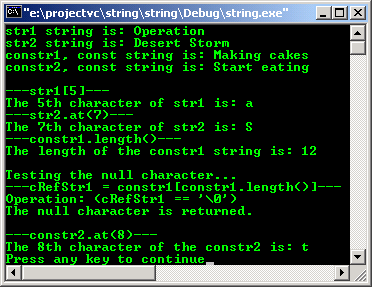
Output:
basic_string::basic_string
Constructs a string that is empty or initialized by specific characters or that is a copy of all or part of some other string object or C-string.
The five member functions and their parameters are shown below but it is not our concern here. We just want to know how to use the member functions in our program.
-
basic_string( const value_type* _Ptr, size_type _Count = npos, const allocator_type& _Al = Allocator() );
-
basic_string( const basic_string& _Right, size_type _Roff = 0, size_type _Count = npos );
-
basic_string( const basic_string& _Right, size_type _Roff = 0, size_type _Count = npos, const allocator_type& _Al = Allocator() );
-
basic_string( size_type _Count, value_type _Ch, const allocator_type& _Al = Allocator() );
-
explicit basic_string( const allocator_type& _Al = Allocator() );
-
template <class InputIterator>basic_string( InputIterator _First, InputIterator _Last, const allocator_type& _Al = Allocator() );
The constructors for class basic_string create and initialize strings as follows:
The first member function creates a string that is initialized by all or part of a C-string.
The second member function creates a string that is initialized by all or part of an object of typebasic_string.
The third member function creates a string that is initialized by a specific number of characters of a parameter stipulated value.
The fourth member function creates an empty string.
The fifth member function creates a string that is initialized by the characters in the range whose boundaries are delimited by input iterators.
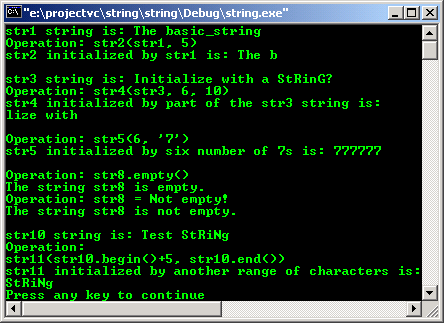
Then, the following program example tries to describe the string object initialization.
// basic_string
#include <string>
#include <iostream>
using namespace std;
int main()
{
// initializing with a C-string
const char *str1 = "The basic_string";
basic_string <char> str2(str1, 5);
cout<<"str1 string is: "<<str1<<endl;
cout<<"Operation: str2(str1, 5)"<<endl;
cout<<"str2 initialized by str1 is: "<<str2<<"\n\n";
// initializing with a string
string str3("Initialize with a StRinG?");
cout<<"str3 string is: "<<str3<<endl;
basic_string <char> str4(str3, 6, 10);
cout<<"Operation: str4(str3, 6, 10)"<<endl;
cout<<"str4 initialized by part of the str3 string is: \n"<<str4<<"\n\n";
// initializing a string with a number of characters of a specific value
basic_string <char> str5(6, '7');
cout<<"Operation: str5(6, '7')"<<endl;
cout<<"str5 initialized by six number of 7s is: "<<str5<<"\n\n";
// creating an empty string and string with a specified allocator
basic_string <char> str6;
string str7;
// allocate a storage
basic_string <char> str8(str7.get_allocator());
// test the emptiness
cout<<"Operation: str8.empty()"<<endl;
if(str8.empty())
cout<<"The string str8 is empty."<<endl;
else
cout<<"The string str8 is not empty."<<endl;
// fill up some string
str8 = "Not empty!";
cout<<"Operation: str8 = Not empty!"<<endl;
// retest again...
if(str8.empty())
cout<<"The string str8 is empty."<<endl;
else
cout<<"The string str8 is not empty."<<endl;
cout<<endl;
// initializing a string from another range of characters
string str10("Test StRiNg");
cout<<"str10 string is: "<<str10<<endl;
cout<<"Operation: \nstr11(str10.begin()+5, str10.end())"<<endl;
basic_string <char> str11(str10.begin()+5, str10.end());
cout<<"str11 initialized by another range of characters is: \n"<<str11<<endl;
return 0;
}
Output:
 |
begin()
If the return value of begin() is assigned to a const_iterator, the string object cannot be modified. If the return value of begin() is assigned to an iterator, the string object can be modified.
// begin(), end()
#include <string>
#include <iostream>
using namespace std;
int main()
{
string Str1("Testing the begin() and end()"), Str2;
basic_string <char>::iterator Str1Iter;
// const_iterator…
basic_string <char>::const_iterator Str1CIter;
// ...an error because the iterator Str1CIter is const...
// *Str1CIter = 'Z';
cout<<"String Str1 is: "<<Str1<<endl;
Str1Iter = Str1.begin();
cout<<"Operation: Str1Iter = Str1.begin()"<<endl;
cout<<"The first character of the string Str1 is: "<<*Str1Iter<<"\n\n";
// using dereferenced iterator to modify a character
*Str1Iter = 'F';
cout<<"Operation: *Str1Iter = 'F'"<<endl;
cout<<"Now, the first character of the new Str1 is: "<<*Str1Iter<<endl;
cout<<"The full modified string Str1 is now: \n"<<Str1<<"\n\n";
// for an empty string, begin() == end()
cout<<"Operation: if(Str2.begin() == Str2.end())"<<endl;
if(Str2.begin() == Str2.end())
cout<<"The string Str2 is empty."<<endl;
else
cout<<"The string Str2 is not empty."<<endl;
cout<<endl;
// fill up some string and retest...
Str2 = "Not empty";
cout<<"Operation: Str2 = \"Not empty\""<<endl;
if(Str2.begin() == Str2.end())
cout<<"Now the string Str2 is empty."<<endl;
else
cout<<"Now the string Str2 is not empty."<<endl;
return 0;
}
Output:

c_str()
Objects of type string belonging to the C++ template class basic_string<char> are not necessarily null terminated. The null character ' \0 ' is used as a special character in a C-string to mark the end of the string but has not special meaning in an object of type string and may be a part of the string just like any other character.
There is an automatic conversion from const char* into strings, but the string class does not provide for automatic conversions from C-style strings to objects of type basic_string<char>.
The returned C-style string should not be modified, as this could invalidate the pointer to the string, or deleted, as the string has a limited lifetime and is owned by the class string.
// c_str(), length(), data(), strlen()
#include <string>
#include <iostream>
using namespace std;
int main( )
{
string str1("Testing the c_str");
cout<<"The original string object str1 is: "<<str1<<endl;
cout<<"Operation: str1.length()"<<endl;
cout<<"The length of the string object str1 = "<<str1.length()<<"\n\n";
// a string to an array of characters conversion
const char *ptr1 = 0;
ptr1= str1.data();
cout<<"Operation: ptr1= str1.data()"<<endl;
cout<<"The string object pointed by ptr1 is: \n"<<ptr1<<endl;
cout<<"\nOperation: strlen(ptr1)"<<endl;
cout<<"The length of character array str1 = "<<strlen(ptr1)<<"\n\n";
// a string to a C-style string conversion
const char *cstr1 = str1.c_str();
cout<<"Operation: *cstr1 = str1.c_str()"<<endl;
cout<<"The C-style string c_str1 is: "<<cstr1<<endl;
cout<<"\nOperation: strlen(cstr1)"<<endl;
cout<<"The length of C-style string str1 = "<<strlen(cstr1)<<endl;
return 0;
}
Output:

capacity()
The member function capacity() returns the storage currently allocated to hold the controlled sequence, a value at least as large as size.
// capacity(), size(), erase(), length(), max_size()
#include <string>
#include <iostream>
using namespace std;
int main( )
{
string str1("Testing the capacity()");
cout<<"str1 string is: "<<str1<<endl;
// the size and length member functions differ in name only
basic_string <char>::size_type SizeStr1, LenStr1;
SizeStr1 = str1.size();
LenStr1 = str1.length();
basic_string <char>::size_type CapStr1, MaxSizeStr1;
CapStr1 = str1.capacity();
MaxSizeStr1 = str1.max_size();
// compare size, length, capacity & max_size of a string
cout<<"\nOperation: str1.size()"<<endl;
cout<<"The size of str1 is: "<<SizeStr1<<" characters"<<endl;
cout<<"\nOperation: str1.length()"<<endl;
cout<<"The length of str1 is: "<<LenStr1<<" characters"<<endl;
cout<<"\nOperation: str1.capacity()"<<endl;
cout<<"The capacity of str1 is: "<<CapStr1<<" characters"<<endl;
cout<<"\nOperation: str1.max_size()"<<endl;
cout<<"The max_size of str1 is: "<<MaxSizeStr1<<" characters"<<endl;
// erase some characters...
str1.erase(6, 5);
// re test...
cout<<"\nOperation: str1.erase(6, 5)"<<endl;
cout<<"The new str1 string is: "<<str1<<"\n\n";
SizeStr1 = str1.size();
LenStr1 = str1.length();
CapStr1 = str1.capacity();
MaxSizeStr1 = str1.max_size();
// compare size, length, capacity & max_size of a string after erasing part of the original string
cout<<"The new size of str1 is: "<<SizeStr1<<" characters"<<endl;
cout<<"The new length of str1 is: "<<LenStr1<<" characters"<<endl;
cout<<"The new capacity of str1 is: "<<CapStr1<<" characters"<<endl;
cout<<"The new max_size of str1 is: "<<MaxSizeStr1<<" characters"<<endl;
return 0;
}
Output:

clear()
The string on which the member function clear() is called will be empty.
// clear()
#include <string>
#include <iostream>
using namespace std;
int main( )
{
string str1("Testing the clear()");
basic_string <char>::iterator StrIter;
// normal...
cout<<"str1 string is :"<<str1<<endl;
// using iterator....iterate character by character...
cout<<"str1 string is: ";
for (StrIter = str1.begin(); StrIter != str1.end(); StrIter++)
cout<<*StrIter;
cout<<endl;
// str1.clear();
cout<<"\nErasing part of the string using erase(13)"<<endl;
str1.erase(13);
cout<<"Operation: str1.erase(13)"<<endl;
cout<<"The modified str1 string is: ";
// using iterator...
for(StrIter = str1.begin(); StrIter != str1.end(); StrIter++)
cout<<*StrIter;
cout<<endl;
// for an empty string, begin is equivalent to end
cout<<"\nOperation: str1.begin()==str1.end()"<<endl;
if(str1.begin() == str1.end())
cout<<"The str1 string is empty."<<endl;
else
cout<<"The str1 string has some data"<<endl;
// erasing all the data...
cout<<"\nOperation: str1.erase(13)"<<endl;
cout<<"Erasing all the data using erase()"<<endl;
str1.erase();
// re test...
cout<<"The modified string str1 is: "<<endl;
cout<<"\nOperation: str1.begin()==str1.end()"<<endl;
if(str1.begin() == str1.end())
cout<<"The str1 string is empty."<<endl;
else
cout<<"The str1 string has some data"<<endl;
return 0;
}
Output:

compare()
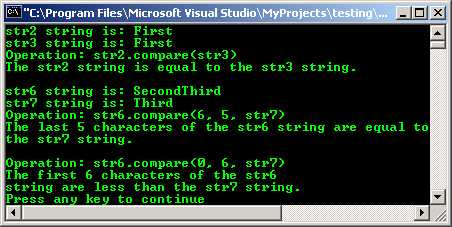
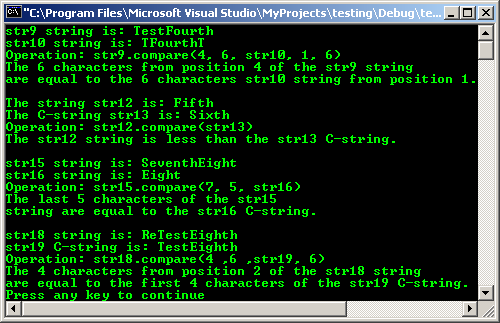
Thecompare() member functions compare either all or part of the parameter and operand strings depending on which in used.
A negative return value if the operand string is less than the parameter string; zero if the two strings are equal; or a positive value if the operand string is greater than the parameter string.
// compare() program example part I
#include <string>
#include <iostream>
using namespace std;
int main()
{
// comparing a string to a string, the character index start from 0
int str1;
string str2("First");
string str3("First");
cout<<"str2 string is: "<<str2<<endl;
cout<<"str3 string is: "<<str3<<endl;
// compare str2 and str3 then assign the result to str1
cout<<"Operation: str2.compare(str3)"<<endl;
str1 = str2.compare(str3);
if(str1 < 0)
cout<<"The str2 string is less than the str3 string."<<endl;
else if(str1 == 0)
cout<<"The str2 string is equal to the str3 string."<<endl;
else
cout<<"The str2 string is greater than the str3 string."<<endl;
cout<<endl;
// comparing part of a string to a string
int str4, str5;
string str6("SecondThird");
string str7("Third");
cout<<"str6 string is: "<<str6<<endl;
cout<<"str7 string is: "<<str7<<endl;
cout<<"Operation: str6.compare(6, 5, str7)"<<endl;
str4 = str6.compare(6, 5, str7);
if(str4 < 0)
cout<<"The last 5 characters of the str6 string are less than\nthe str7 string."<<endl;
else if(str4 == 0)
cout<<"The last 5 characters of the str6 string are equal to\nthe str7 string."<<endl;
else
cout<<"The last 5 characters of the str6 string is greater than\nthe str7 string."<<endl;
cout<<endl;
cout<<"Operation: str6.compare(0, 6, str7)"<<endl;
str5 = str6.compare(0, 6, str7);
if(str5 < 0)
cout<<"The first 6 characters of the str6 \nstring are less than the str7 string."<<endl;
else if(str5 == 0)
cout<<"The first 6 characters of the str6 \nstring are equal to the str7 string."<<endl;
else
cout<<"The first 6 characters of the str6 \nstring is greater than the str7 string."<<endl;
return 0;
}
Output:
// compare() program example part II
#include <string>
#include <iostream>
using namespace std;
int main()
{
// comparing part of a string to part of a string
int str8;
string str9("TestFourth");
string str10("TFourthT");
cout<<"str9 string is: "<<str9<<endl;
cout<<"str10 string is: "<<str10<<endl;
str8 = str9.compare(4, 6, str10, 1, 6);
cout<<"Operation: str9.compare(4, 6, str10, 1, 6)"<<endl;
if(str8 < 0)
cout<<"The 6 characters from position 4 of the str9 string \nare less than "
<<"the 6 characters str10 string from position 1."<<endl;
else if(str8 == 0)
cout<<"The 6 characters from position 4 of the str9 string\nare equal to "
<<"the 6 characters str10 string from position 1."<<endl;
else
cout<<"The 6 characters from position 4 of the str9 string\nis greater than "
<<"the 6 characters str10 string from position 1."<<endl;
cout<<endl;
// comparing a string to a C-string
int str11;
string str12("Fifth");
const char* str13 = "Sixth";
cout<<"The string str12 is: "<<str12<<endl;
cout<<"The C-string str13 is: "<<str13<<endl;
str11 = str12.compare(str13);
cout<<"Operation: str12.compare(str13)"<<endl;
if(str11 < 0)
cout<<"The str12 string is less than the str13 C-string."<<endl;
else if(str11 == 0)
cout<<"The str12 string is equal to the str13 C-string."<<endl;
else
cout<<"The str12 string is greater than the str13 C-string."<<endl;
cout << endl;
// comparing part of a string to a C-string
int str14;
string str15("SeventhEight");
const char* str16 = "Eight";
cout<<"str15 string is: "<<str15<<endl;
cout<<"str16 string is: "<<str16<<endl;
str14 = str15.compare(7, 5, str16);
cout<<"Operation: str15.compare(7, 5, str16)"<<endl;
if(str14 < 0)
cout<<"The last 5 characters of the str15 \nstring are less than the str16 C-string."<<endl;
else if(str14 == 0)
cout<<"The last 5 characters of the str15 \nstring are equal to the str16 C-string."<<endl;
else
cout<<"The last 5 characters of the str15 \nstring is greater than the str16 C-string."<<endl;
cout << endl;
// comparing part of a string to part of an equal length of a C-string
int str17;
string str18("ReTestEighth");
const char* str19 = "TestEighth";
cout<<"str18 string is: "<<str18<<endl;
cout<<"str19 C-string is: "<<str19<<endl;
str17 = str18.compare(2, 4, str19, 4);
cout<<"Operation: str18.compare(4, 6, str19, 6)"<<endl;
if(str17 < 0)
cout<<"The 4 characters from position 2 of the str18 string \nare less than "
<<"the first 4 characters of the str19 C-string."<<endl;
else if(str17 == 0)
cout<<"The 4 characters from position 2 of the str18 string \nare equal to "
<<"the first 4 characters of the str19 C-string."<<endl;
else
cout<<"The 4 characters from position 2of the str18 string \nis greater than "
<<"the first 4 characters of the str19 C-string."<<endl;
return 0;
}
Output:
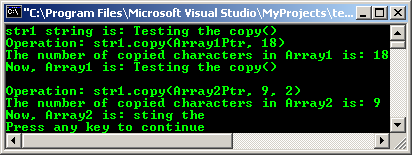
copy()
A null character is not appended to the end of the copy.
The return value is the number of characters actually copied.
// copy()
#include <string>
#include <iostream>
using namespace std;
int main()
{
string str1("Testing the copy()");
basic_string <char>::iterator StrIter;
// declare and initialize arrays to 0
char Array1[20] = {0};
char Array2[10] = {0};
basic_string <char>:: pointer Array1Ptr = Array1;
basic_string <char>:: value_type *Array2Ptr = Array2;
// iterate character by character...
cout<<"str1 string is: ";
for(StrIter = str1.begin(); StrIter != str1.end(); StrIter++)
cout<<*StrIter;
cout<<endl;
basic_string <char>::size_type NewArray1;
NewArray1 = str1.copy(Array1Ptr, 18);
cout<<"Operation: str1.copy(Array1Ptr, 18)"<<endl;
cout<<"The number of copied characters in Array1 is: "<<unsigned int(NewArray1)<<endl;
cout<<"Now, Array1 is: "<<Array1<<"\n\n";
basic_string <char>::size_type NewArray2;
NewArray2 = str1.copy(Array2Ptr, 9, 2);
cout<<"Operation: str1.copy(Array2Ptr, 9, 2)"<<endl;
cout<<"The number of copied characters in Array2 is: "<<unsigned int(NewArray2)<<endl;
cout<<"Now, Array2 is: "<<Array2Ptr<<endl;
return 0;
}
Output:
tenouk C++ STL programming tutorial
Further C++ string related reading:
Acomplete C++ Standard Library documentation that includes STL.
Check thebest selling C / C++, STL and UML books at Amazon.com.
The source code for this tutorial is available atC++ Characters & Strings source codes.