| Main |< C & C++ for loop 1 | C & C++ while & do-while loop 1 >|Site Index |Download |
C LAB WORKSHEET 7_1
A C & C++ Repetition: The for Loop 2
Items in this page:
More for loop exercises, questions and answers.
The related tutorial reference for this worksheet are:C & C++ program control 1 andC/C++ program control 2.
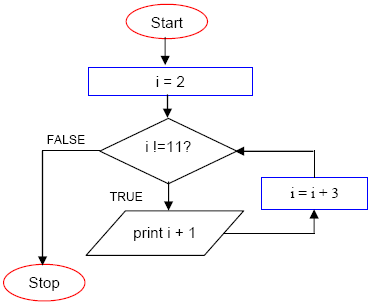
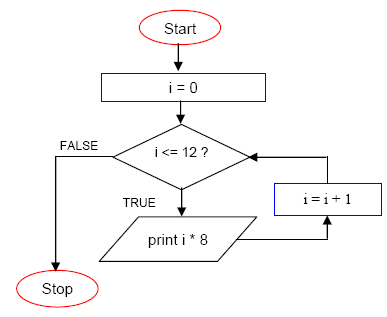
printf("%d\t", i + 1); |
|
printf("%d\t", i + 1); |
|
printf("%d\t", i + 1); |
|
printf("%d\t", i + 1); |
|
printf("%d\t", i + 1); |
|
|
|
|
|
|
| |
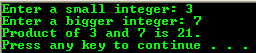
| #include <stdio.h>
void main() { int i = 0, x = 0, y = 0, sum = 0; printf("Enter a small integer: "); scanf_s("%d", &x, sizeof(int)); printf("Enter a bigger integer: "); scanf_s("%d", &y, sizeof(int)); for(i = x; i >=1; i = i -1) sum = sum + y; printf("Product of %d and %d is %d\n.\n", x, y, sum); }
|
| /* Print out all integers from 5 down to -5 */ #include <stdio.h>
void main() { int i; for(i = 5; i >=-5; i = i-1) printf("%d ", i); printf("\n"); }
|
|
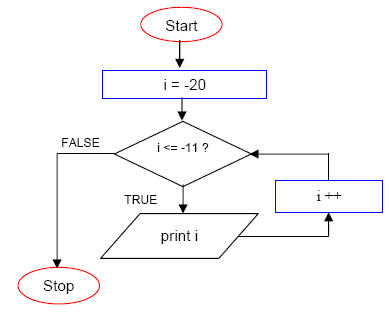
/* Print out all integers from -11 down to -20. */ #include <stdio.h> void main() { int i; for(i = -20; i <=-11; i++) printf("%d ", i); printf("\n"); }
|
|
|
|
/* Print out the squares of the first 10 integers */ #include <stdio.h>
void main() { int i; for(i = 0; i <= 10; i++) printf("%d ", i*i); printf("\n"); }
|
| |
| #include <stdio.h>
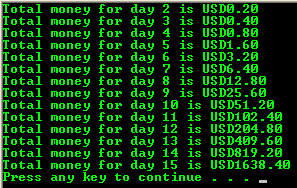
void main() { int i; // first day got 10 cent double sum = 0.10; // start on 2nd day, got twice for(i = 2; i <= 15;) { // the next day got twice the previous day sum = sum + sum; printf("Total money for day %d is USD%.2f\n", i, sum); // after complete the calculation, go to the next day i++; } }
|










More Example And Practice
All loops must start somewhere; this called the initialization of the loop. They must stop sometime, the termination of the loop, or else they keep executing, resulting the infinite loop (use CTRL-C to terminate the program for PC compatible). To terminate a loop, we will need to evaluate conditions, for example, whether a variable is equal to a value or not. Furthermore, while the loop is going through its iterations, it must come closer and closer to the terminal condition.
|
|


The previous code illustrates a very simple loop. The numbers in the comments identify selected statements. A tracechart is shown alongside the code. In step 1 of the trace,statement 1 of the code is executed, that is1 is assigned to i. In statement 2 a question is asked. Isi less than or equal to 2? Yes, so the loop, which is composed of the two statements inside the set of braces, is executed. Statement 3 shows that i, with a value of 1, is printed and then i is incremented to 2. Here, we draw a horizontal line in the tracechart to depict that the execution goes up to the for statement.
In step 5, is i less than or equal to 2? Yes, so we go through the loop again, printing 2 for i and incrementing it to 3. Now we have complemented the second iteration of the loop. In step 8, checking to see if i <= 2, we see that it is false and we stop the loop. The flowchart is given below.
|
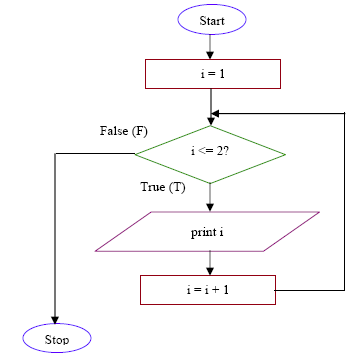
The flowchart starts at the oval labeled Start and ends at the one labeled Stop. A rectangle is used for assignments.i is assigned 1 to begin. Then we encounter a decision diamond. Here we take the T for the true route and fall into the loop until the condition of i <= 2? becomes false, where we stop.
With a minimum number of changes, convert this flowchart so that all the integers from 3 to 7 are printed and write the code.
Write the code and draw the flowchart that will print 3, 5 and 7 instead of 3, 4, 5, 6 and 7. From the flowchart write the tracechart.
You can show the iteration number of the loop by modifying the previous program as shown below.
|
|
Write a program that will ask the user to give three integers. Call these integers start,step_by and stop. After these three integers are scanned in, set up the for loop that will start i at the value of start, make it increase by the value given by step_by and make it stop at the value stored in stop. Print these values as shown in the following output sample.
-----------Output--------------- Enter three integers: 23 3 32 23 26 29 32 | #include <stdio.h>
void main() { int i, start = 0, step_by = 0, stop =0; printf_s("Enter three integers: "); scanf_s("%d %d %d", &start, &step_by, &stop); for(i = start; i <=stop; i = i + step_by) printf("%d ", i); printf("\n"); }
|
Write a program that will add up all the integers from 1 to the integer that was scanned into the variable j. Store the sum in the variable called sum and use i to increment the integers from 1 to j. Print only sum. For example, if 5 were read into j, then sum would be 1 + 2 + 3 + 4 + 5 or 15. A sample output is given below.
---------Output---------------- Give an integer: 6 Sum of integers from 1 to 6 is 24. | #include <stdio.h>
void main() { int i, j, sum = 0; printf_s("Give an integer: "); scanf_s("%d", &j); for(i = 1; i <=j; ++i) sum = sum + i; printf("Sum of integers from 1 to %d is %d\n", j, sum); }
|


The Nested Loop: Loop in Loop
The for loop and all other repetition constructs can also be nested to any degree. In a simple word, nesting means loop in loop. Let try the following program example.
// a program to show the nested for loops #include<stdio.h>
int main() { // variables for counter… int i, j; // outer loop, execute this first... // for every i iteration, execute the inner loop for(i=1; i<10;) { // display i printf("%d", i); // then, execute inner loop with loop index j the initial value of j is i + 1 for(j=i+1; j<10; ) { // display result of j iteration printf("%d", j); // increment j by 1 until j<10 j = j + 1; } // go to new line printf("\n"); // increment i by 1, repeat until i<10 i = i + 1; } return 0; } |
|

The program has two for loops. The loop index i for the outer (first) loop runs from 1 to 9 and for each value of i, the loop index j for the inner loop runs from i + 1 to 9. Note that for the last value of i (i.e. 9), the inner loop is not executed at all because the starting value of j is 10 and the expression j < 10 yields the value false because j = 10.
The following is another nested example; study the program code and the output. In general, a nested two for loops can be depicted as a row and column.
|
|

The first for loop is executed until the row is 1 (row > 0). For every row value, the inner for loop will be executed until col = 1 (col > 0). In a simple word, the externalfor loop will print the row and the internal for loop will print the column.
For the previous two nestedfor loop program example, build the flowcharts.Ans: as shown below.
|
|


| Main |< C & C++ for loop 1 | C & C++ while & do-while loop 1 >|Site Index |Download |
The C Repetition for, while and do-while:Part 1 |Part 2 |Part 3 |Part 4