|< C++ STL Container 9 | Main | C++ STL Container 11 >|Site Index |Download |
MODULE 29b
THE C++ STL CONTAINER PART 10
map, multimap, hash_map, hash_multimap, hash_set,hash_multiset
| My Training Period: hours
This is a continuation from previous C++ STL Container, compiled usingVC++7.0/.Net, win32 empty console mode application. Be careful with the source codes than span more than one line. g++ compilation examples are given at the end of this Module. Source code is available inC++ STL Container source code.
The C++ STL containers programming abilities that supposed to be acquired:
What do we have in this session?
29.5.3 hash_set
<hash_set> Header Members
Operators
| ||||||||||||||||
Specialized Template Functions
Specialized template function | Description |
swap() | Exchanges the elements of two hash_sets or hash_multisets. |
Table 29.23 | |
Classes
Class | Description |
hash_compare | Describes an object that can be used by any of the hash associative containers —hash_map, hash_multimap,hash_set, or hash_multiset — as a default Traitsparameter object to order and hash the elements they contain. |
hash_set | Used for the storage and fast retrieval of data from a collection in which the values of the elements contained are unique and serve as the key values. |
hash_multiset | Used for the storage and fast retrieval of data from a collection in which the values of the elements contained are unique and serve as the key values. |
Table 29.24 | |
hash_set Template Class Members
Typedefs
Typedef | Description |
allocator_type | A type that represents the allocator class for the hash_set object. |
const_iterator | A type that provides a bidirectional iterator that can read a const element in the hash_set. |
const_pointer | A type that provides a pointer to aconst element in a hash_set. |
const_reference | A type that provides a reference to a const element stored in a hash_set for reading and performing const operations. |
const_reverse_iterator | A type that provides a bidirectional iterator that can read any const element in the hash_set. |
difference_type | A signed integer type that can be used to represent the number of elements of a hash_set in a range between elements pointed to by iterators. |
iterator | A type that provides a bidirectional iterator that can read or modify any element in a hash_set. |
key_compare | A type that provides a function object that can compare two sort keys to determine the relative order of two elements in the hash_set. |
key_type | A type that describes an object stored as an element of a hash_set in its capacity as sort key. |
pointer | A type that provides a pointer to an element in a hash_set. |
reference | A type that provides a reference to an element stored in a hash_set |
reverse_iterator | A type that provides a bidirectional iterator that can read or modify an element in a reversed hash_set. |
size_type | An unsigned integer type that can represent the number of elements in a hash_set. |
value_compare | A type that provides two function objects, a binary predicate of class compare that can compare two element values of a hash_set to determine their relative order and a unary predicate that hashes the elements. |
value_type | A type that describes an object stored as an element of a hash_set in its capacity as a value. |
Table 29.25 | |
hash_set Template Class Member Functions
Member function | Description |
begin() | Returns an iterator that addresses the first element in the hash_set. |
clear() | Erases all the elements of a hash_set. |
count() | Returns the number of elements in a hash_set whose key matches a parameter-specified key. |
empty() | Tests if a hash_set is empty. |
end() | Returns an iterator that addresses the location succeeding the last element in a hash_set. |
equal_range() | Returns a pair of iterators respectively to the first element in a hash_set with a key that is greater than a specified key and to the first element in the hash_set with a key that is equal to or greater than the key. |
erase() | Removes an element or a range of elements in a hash_set from specified positions or removes elements that match a specified key. |
find() | Returns an iterator addressing the location of an element in a hash_set that has a key equivalent to a specified key. |
get_allocator() | Returns a copy of the allocator object used to construct the hash_set. |
hash_set() | Constructs a hash_set that is empty or that is a copy of all or part of some other hash_set. |
insert() | Inserts an element or a range of elements into a hash_set. |
key_comp() | Retrieves a copy of the comparison object used to order keys in a hash_set. |
lower_bound() | Returns an iterator to the first element in a hash_set with a key that is equal to or greater than a specified key. |
max_size() | Returns the maximum length of the hash_set. |
rbegin() | Returns an iterator addressing the first element in a reversed hash_set. |
rend() | Returns an iterator that addresses the location succeeding the last element in a reversed hash_set. |
size() | Returns the number of elements in the hash_set. |
swap() | Exchanges the elements of two hash_sets. |
upper_bound() | Returns an iterator to the first element in a hash_set that with a key that is equal to or greater than a specified key. |
value_comp() | Retrieves a copy of the hash traits object used to hash and order element key values in a hash_set. |
Table 29.26 | |
hash_set Class
The container class hash_set is an extension of the Standard Template Library (STL) and is used for the storage and fast retrieval of data from a collection in which the values of the elements contained are unique and serve as the key values.
template <class Key, class Traits=hash_compare<Key, less<Key> >, class Allocator=allocator<Key> >
Parameters
Parameter | Description |
Key | The element data type to be stored in the hash_set. |
Traits | The type which includes two function objects, one of class compare that is a binary predicate able to compare two element values as sort keys to determine their relative order and a hash function that is a unary predicate mapping key values of the elements to unsigned integers of type size_t. This argument is optional, and the hash_compare<Key, less<Key> >is the default value. |
Allocator | The type that represents the stored allocator object that encapsulates details about the hash_set's allocation and de-allocation of memory. This argument is optional, and the default value is allocator<Key>. |
Table 29.27 | |
|
hash_set Constructor
Constructs a hash_set that is empty or that is a copy of all or part of some other hash_set.
All constructors store a type of allocator object that manages memory storage for the hash_set and that can later be returned by callingget_allocator(). The allocator parameter is often omitted in the class declarations and preprocessing macros used to substitute alternative allocators.
All constructors initialize their hash_sets.
All constructors store a function object of type Traits that is used to establish an order among the keys of the hash_set and that can later be returned by calling key_comp.
The first three constructors specify an empty initial hash_set, the second specifying the type of comparison function (_Comp) to be used in establishing the order of the elements and the third explicitly specifying the allocator type (_Al) to be used.
The key word explicit suppresses certain kinds of automatic type conversion.
The fourth constructor specifies a copy of the hash_set_Right.
The last three constructors copy the range [_First, _Last) of a hash_set with increasing explicitness in specifying the type of comparison function of class Traits andallocator.
The actual order of elements in a hash_set container depends on the hash function, the ordering function and the current size of the hash table and cannot, in general, be predicted as it could with the set container, where it was determined by the ordering function alone.
// hash_set, constructor, compiled with VC7.0/.Net with some warnings
#include <hash_set>
#include <iostream>
using namespace std;
int main()
{
hash_set <int>::iterator hst0_Iter, hst1_Iter, hst3_Iter, hst4_Iter, hst5_Iter;
hash_set <int, hash_compare <int, greater<int> > >::iterator hst2_Iter;
// create an empty hash_set hst0 of key type integer
hash_set <int> hst0;
// create an empty hash_set hst1 with the key comparison function of less than, then insert 5 elements
hash_set <int, hash_compare<int, less<int> > > hst1;
hst1.insert(7);
hst1.insert(3);
hst1.insert(12);
hst1.insert(51);
hst1.insert(10);
// create an empty hash_set hst2 with the key comparison function of greater than, then insert 4 elements
hash_set<int, hash_compare<int, greater<int> > > hst2;
hst2.insert(71);
hst2.insert(68);
hst2.insert(68);
hst2.insert(55);
// create a hash_set hst3 with the hash_set hst1 allocator
hash_set<int>::allocator_type hst1_Alloc;
hst1_Alloc = hst1.get_allocator();
hash_set<int> hst3(less<int>(),hst1_Alloc);
hst3.insert(12);
hst3.insert(13);
hst3.insert(12);
// create a hash_set hst4 by copying the range hst1[_First, _Last)
hash_set <int>::const_iterator hst1_PIter, hst1_QIter;
hst1_PIter = hst1.begin();
hst1_QIter = hst1.begin();
hst1_QIter++;
hst1_QIter++;
hash_set<int> hst4(hst1_PIter, hst1_QIter);
// create a hash_set hst5 by copying the range hst4[_First, _Last) and with the allocator of hash_set hst2
hash_set <int>::allocator_type hst2_Alloc;
hst2_Alloc = hst2.get_allocator();
hash_set <int> hst5(hst1.begin(), ++hst1.begin(), less<int>(), hst2_Alloc);
// --------------------------------------------------------------
cout<<"Operation: hash_set <int> hst0\n";
cout<<"hst0 data: ";
for(hst0_Iter = hst0.begin(); hst0_Iter != hst0.end(); hst0_Iter++)
cout<<*hst0_Iter<<" ";
cout<<endl;
cout<<"\nOperation: hash_set <int, hash_compare<int, \nless<int> > > hst1\n";
cout<<"Operation: hst1.insert(7)...\n";
cout<< "hst1 data: ";
for(hst1_Iter = hst1.begin(); hst1_Iter != hst1.end(); hst1_Iter++)
cout<<*hst1_Iter << " ";
cout<<endl;
cout<<"\nOperation: hash_set <int, hash_compare<int, \ngreater<int> > > hst2\n";
cout<<"Operation: hst2.insert(71)...\n";
cout<<"hst2 data: ";
for(hst2_Iter = hst2.begin(); hst2_Iter != hst2.end(); hst2_Iter++)
cout<<*hst2_Iter<<" ";
cout<<endl;
cout<<"\nOperation: hash_set<int> hst3(less<int>(),hst1_Alloc)\n";
cout<<"Operation: hst3.insert(12)...\n";
cout<<"hst3 data: ";
for(hst3_Iter = hst3.begin(); hst3_Iter != hst3.end(); hst3_Iter++)
cout<<*hst3_Iter<<" ";
cout<<endl;
cout<<"\nOperation: hash_set<int> hst4(hst1_PIter, hst1_QIter)\n";
cout<<"hst4 data: ";
for(hst4_Iter = hst4.begin(); hst4_Iter != hst4.end(); hst4_Iter++)
cout<<*hst4_Iter<<" ";
cout<<endl;
cout<<"\nOperation: hash_set <int> hst5(hst1.begin(), \n++hst1.begin(), less<int>(), hst2_Alloc)\n";
cout<<"hst5 data: ";
for(hst5_Iter = hst5.begin(); hst5_Iter != hst5.end(); hst5_Iter++)
cout<<*hst5_Iter<<" ";
cout<<endl;
return 0;
}
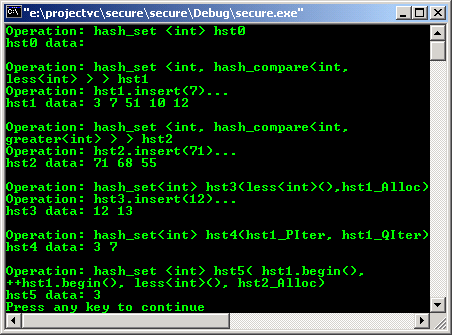
Output:
---------------------------------------------End of the hash_set----------------------------------------
Further C++ STL container classes reading:
Source code is available inC++ STL Container source code.
Acomplete C++ Standard Library documentation that includes STL.