|< C++ Inheritance 4 | Main | C++ Multi Inheritance 1 >|Site Index |Download |
MODULE 15a_1
FINAL PART ON C++ INHERITANCE 5
|
| My Training Period: xx hours
This is a continuation from previous Module and a final part. The source code for this tutorial is available in C++ Inheritance source codes.
15.12 Friend Functions And Class
private: friend void set(int new_length, int new_width); // friend method friend int get_area(void) {return (length * width);} // friend method
// using friend function... #include <iostream> using namespace std;
class SampleFriend { // private member variable int i; friend int friend_funct(SampleFriend *, int); // friend_funct is not private, // even though it's declared in the private section public: // constructor SampleFriend(void) { i = 0;}; int member_funct(int); };
// implementation part, both functions access private int i int friend_funct(SampleFriend *xptr, int a) { return xptr->i = a; }
int SampleFriend::member_funct(int a) { return i = a; }
main() { SampleFriend xobj; // note the difference in function calls
cout<<"\nfriend_funct(&xobj, 10) is "<<friend_funct(&xobj, 10)<<"\n\n"; cout<<"xobj.member_funct(10) is "<<xobj.member_funct(10)<<endl; }
Output:
|

You can make all or part of the functions of class, let say, Y, into friends of class X. For example,
class One
{
friend Two;
int i;
void member_funcOne();
};
class Two;
{
void friend_One1(One&);
void friend_One2(One*);
...
...
};
The functions declared in Two are friends ofOne, although they have no friend specifiers. They can access the private members of One, such as i and member_funcOne.
More Working Program Examples and Experiments
// inheritance again...
// notice the sequence of the constructor
// and destructor, and private, public, protected usage...
#include <iostream>
using namespace std;
class Base
{
// available for this class member functions ONLY...
private:
int BaseVar;
int NewX;
int ExtraBaseVar;
// available to this and derived classes...
protected:
int BaseVarOne;
// available to the derived and outside classes...
public:
Base();
Base(int NewX);
~Base();
public:
int SetBaseData();
int ShowBaseData(){return BaseVar;}
int SimilarNameFunct();
};
class DerivedOne:public Base
{
// available to this class member functions ONLY...
private:
int DerivedOneVar;
int ExtraDerivedVar;
// available to the derived and outside classes...
public:
DerivedOne();
~DerivedOne();
// available to the derived and outside classes...
public:
void SetDerivedOneData();
int ShowDerivedOneData()
{
// BaseVarOne is base class protected member
// variable, available to this derived class...
return (DerivedOneVar + BaseVarOne);
}
int SimilarNameFunct();
};
// base class constructor...
Base::Base()
{
BaseVar = 100;
// constructor counter...
static int p;
cout<<"Invoking base class constructor #"<<p<<endl;
p++;
}
// another base class constructor...
Base::Base(int)
{
// constructor counter...
static int t;
cout<<"Invoking 2nd base class constructor #"<<t<<endl;
t++;
BaseVar = NewX;
}
// base class member function...
int Base::SetBaseData()
{ return NewX = 230;}
int Base::SimilarNameFunct()
{return ExtraBaseVar = 170;}
// base class destructor...
Base::~Base()
{
// destructor counter...
static int q;
cout<<"Invoking base class destructor #"<<q<<endl;
q++;
}
// derived class constructor...
DerivedOne::DerivedOne()
{
DerivedOneVar = 200;
// this member variable is inherited from protected base class
BaseVarOne = 250;
// constructor counter...
static int r;
cout<<"Invoking derived class constructor #"<<r<<endl;
r++;
}
// derived class destructor...
DerivedOne::~DerivedOne()
{
// destructor counter...
static int s;
cout<<"Invoking derived class destructor #"<<s<<endl;
s++;
}
void DerivedOne::SetDerivedOneData()
{}
// same member function name as base class
// it is valid since they are from different class
int DerivedOne::SimilarNameFunct()
{return ExtraDerivedVar = 260;}
void main()
{
// instantiate objects with class types...
Base ObjOne, ObjFour;
DerivedOne ObjTwo, ObjFive;
Base ObjThree;
cout<<"Base class data = "<<ObjOne.ShowBaseData()<<endl;
cout<<"SimilarNameFunct() of base class = "<<ObjFour.SimilarNameFunct()<<endl;
cout<<"DerivedOne class data = "<<ObjTwo.ShowDerivedOneData()<<endl;
cout<<"SimilarNameFunct() of derived class = "<<ObjFive.SimilarNameFunct()<<endl;
cout<<"Another base class data = "<<ObjThree.SetBaseData()<<endl;
}
Output:

|
// program inherit3.cpp
#include <iostream>
usingnamespace std;
// base and derived class declaration part
class vehicle
{
protected:
int wheels;
double weight;
public:
void initialize(int input_wheels, double input_weight);
int get_wheels(void) {return wheels;}
double get_weight(void) {return weight;}
double wheel_load(void) {return (weight/wheels);}
};
// public keyword changed to private - private inheritance
class car : private vehicle
{
int passenger_load;
public:
void initialize(int input_wheels, double input_weight,int people = 4);
int passengers(void) {return passenger_load;}
};
// public keyword change to private - private inheritance
class truck : private vehicle
{
int passenger_load;
double payload;
public:
void init_truck(int how_many = 4, double max_load = 24000.0);
double efficiency(void);
int passengers(void) {return passenger_load;}
};
// main program
int main()
{
vehicle unicycle;
unicycle.initialize(1, 12.5);
cout<<"Using base class, vehicle with public methods\n";
cout<<"---------------------------------------------\n";
cout<<"The unicycle has "<<unicycle.get_wheels()<<" wheel.\n";
cout<<"The unicycle's wheel load is "<<unicycle.wheel_load()<<" kg on the single
tire.\n";
cout<<"The unicycle weighs "<<unicycle.get_weight()<<" kg.\n\n";
car sedan_car;
sedan_car.initialize(4, 3500.0, 5);
cout<<"\nThese two are public-->sedan_car.initialize(4,3500.0,5)\n";
cout<<" and sedan_car.passengers()\n";
cout<<"-------------------------------------------------------\n";
cout<<"The sedan car carries "<<sedan_car.passengers()<<" passengers.\n";
// methods get_weight() and wheel_load() not available
// because we use private inheritance
// cout<<"The sedan car weighs "<<sedan_car.get_weight()<<" kg.\n";
// cout<<"The sedan car's wheel loading is "<<sedan_car.wheel_load()<<" kg per
// tire.\n\n";
truck trailer;
// trailer.initialize(18, 12500.0);
// this method is private now
trailer.init_truck(1, 33675.0);
cout<<"\nThese are public-->trailer.init_truck(1, 33675.0),\n";
cout<<" trailer.efficiency() and trailer.passengers()\n";
cout<<"--------------------------------------------------\n";
cout<<"\nOthers are private...\n";
// methods get_weight() and efficiency() not available
// because we use private inheritance
// cout<<"The trailer weighs "<<trailer.get_weight()<<" kg.\n";
// cout<<"The trailer's efficiency is "<<100.0 * trailer.efficiency()<<" %.\n";
return 0;
}
// class implementation part
// initialize to any data desired, method own by base class
void vehicle::initialize(int input_wheels,double input_weight)
{
wheels = input_wheels;
weight = input_weight;
}
// method own by derived class
void car::initialize(int input_wheels,double input_weight,int people)
{ // wheels and weight still available because of the protected keyword
passenger_load = people;
wheels = input_wheels;
weight = input_weight;
}
void truck::init_truck(int how_many,double max_load)
{
passenger_load = how_many;
payload = max_load;
}
double truck::efficiency(void)
{
return (payload / (payload + weight));
}
Output:
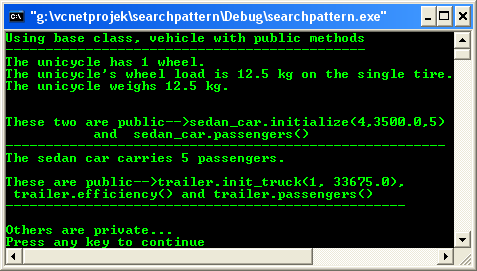
A program example compiled using g++.
///// -herit.cpp- ///////////////////////
// notice the sequence of the constructor
// and destructor, and the use of private,
// public and protected. The inheritance...
//////-FEDORA 3, g++ x.x.x- /////////////
#include <iostream>
using namespace std;
class Base
{
// available for this class member functions ONLY...
private: // the keyword is optional for private
int BaseVar;
int NewX;
int ExtraBaseVar;
// available to this and derived classes...
protected:
int BaseVarOne;
// available to the derived and outside classes...
public:
Base();
Base(int NewX);
~Base();
public:
int SetBaseData();
int ShowBaseData(){return BaseVar;}
int SimilarNameFunct();
};
class DerivedOne:public Base
{
// available to this class member functions ONLY...
private:
int DerivedOneVar;
int ExtraDerivedVar;
// available to the derived and outside classes...
public:
DerivedOne();
~DerivedOne();
// available to the derived and outside classes...
public:
void SetDerivedOneData();
int ShowDerivedOneData()
{
// BaseVarOne is base class protected member
// variable, available to this derived class...
return (DerivedOneVar + BaseVarOne);
}
int SimilarNameFunct();
};
// base class constructor...
Base::Base()
{
BaseVar = 100;
// constructor counter...
static int p;
cout<<"Invoking base class constructor #"<<p<<endl;
p++;
}
// another base class constructor...
Base::Base(int)
{
// constructor counter...
static int t;
cout<<"Invoking 2nd base class constructor #"<<t<<endl;
t++;
BaseVar = NewX;
}
// base class member function...
int Base::SetBaseData()
{return NewX = 230;}
int Base::SimilarNameFunct()
{return ExtraBaseVar = 170;}
// base class destructor...
Base::~Base()
{
// destructor counter...
static int q;
cout<<"Invoking base class destructor #"<<q<<endl;
q++;
}
// derived class constructor...
DerivedOne::DerivedOne()
{
DerivedOneVar = 200;
// this member variable is inherited from protected base class
BaseVarOne = 250;
// constructor counter...
static int r;
cout<<"Invoking derived class constructor #"<<r<<endl;
r++;
}
// derived class destructor...
DerivedOne::~DerivedOne()
{
// destructor counter...
static int s;
cout<<"Invoking derived class destructor #"<<s<<endl;
s++;
}
void DerivedOne::SetDerivedOneData()
{ }
// same member function name as base class
// it is valid since they are from different class
int DerivedOne::SimilarNameFunct()
{return ExtraDerivedVar = 260;}
int main()
{
// instantiate objects with class types...
Base ObjOne, ObjFour;
DerivedOne ObjTwo, ObjFive;
Base ObjThree;
cout<<"Base class data = "<<ObjOne.ShowBaseData()<<endl;
cout<<"SimilarNameFunct() of base class = "<<ObjFour.SimilarNameFunct()<<endl;
cout<<"DerivedOne class data = "<<ObjTwo.ShowDerivedOneData()<<endl;
cout<<"SimilarNameFunct() of derived class = "<<ObjFive.SimilarNameFunct()<<endl;
cout<<"Another base class data = "<<ObjThree.SetBaseData()<<endl;
return 0;
}
[bodo@bakawali ~]$ g++ herit.cpp -o herit
[bodo@bakawali ~]$ ./herit
Invoking base class constructor #0
Invoking base class constructor #1
Invoking base class constructor #2
Invoking derived class constructor #0
Invoking base class constructor #3
Invoking derived class constructor #1
Invoking base class constructor #4
Base class data = 100
SimilarNameFunct() of base class = 170
DerivedOne class data = 450
SimilarNameFunct() of derived class = 260
Another base class data = 230
Invoking base class destructor #0
Invoking derived class destructor #0
Invoking base class destructor #1
Invoking derived class destructor #1
Invoking base class destructor #2
Invoking base class destructor #3
Invoking base class destructor #4
tenouk C++ inheritance object oriented tutorial
Further C++ Inheritance reading:
- TheC++ .NET programming tutorials.
- This is a continuation from previous Module. The source code for this tutorial is available inC++ Inheritance source codes.
- Check the best selling C / C++ and object oriented books at Amazon.com.
- See MFC library class hierarchy chart here.
- Find a lot of information about C++ history and evolution at Bjarne Stroustrup site (http://www.stroustrup.com/).