Enter a sample input: 16,22,13, 19,11, -1 for the following experiment.
#include<stdio.h> int main(void) { int k, smallest; printf("Enter integers, when"); printf(" done enter a "); printf("negative number\n"); scanf_s("%d", &k, 1); // assign the first number to smallest variable smallest = k; // iterate while k >= 0 for( ; k >= 0; ) { // if the entered number is < smallest if(k < smallest) { // then assign the number to smallest variable... smallest = k; // do some checking... printf("The smallest number has just been changed to %d\n", smallest); } // read the next input....repeat scanf_s("%d", &k, 1); } // print the smallest number... printf("The smallest number is %d\n", smallest); return 0; } Draw the flowchart. When running this program, how many timessmallest changed? When running this program with the following data: 11, 22, 13, 19, 16, -1, how many times did smallest change? Are the braces lined up with the if statement necessary to give the same result? Now try to alter the program so that it also prints the data item that was entered. For example, with the following data: 11, 22, 13, 19, 16, -1, this should be printed: “The smallest is 11 and it was data item number 1.” If you can’t do it, don’t be concerned. The solution is in the next experiment.
To see the program flow clearer, you can add some codes as shown below and the output sample is on the right side. #include <stdio.h> int main(void) { int k, smallest; printf("Enter integers, when"); printf(" done enter a "); printf("negative number\n"); scanf_s("%d", &k, 1); // assign the first number to smallest variable smallest = k; printf("smallest=%d, k=%d pos1\n", smallest, k); // iterate while k >= 0 for( ; k >= 0; ) { // if the entered number is < smallest if(k < smallest) { // then assign the number to smallest variable... smallest = k; // do some checking... printf("smallest=%d, k=%d pos2\n", smallest, k); printf("The smallest number has just been changed to %d\n", smallest); } // read the next input....repeat scanf_s("%d", &k, 1); printf("smallest=%d, k=%d pos3\n", smallest, k); } // print the smallest number... printf("The smallest number is %d\n", smallest); return 0; }
| 
3 times. 0 times, because the smallest number is the first entered data. Yes.
#include <stdio.h> int main(void) { int k, i, item_num = 1, smallest; printf("Enter integers, when"); printf(" done enter a "); printf("negative number\n"); scanf_s("%d", &k, 1); // assign the first number to smallest variable smallest = k; // iterate while k >= 0 for(i=1; k >= 0; i++) { // if the entered number is < smallest if(k < smallest) { // then assign the number to smallest variable... smallest = k; item_num = i; // do some checking... printf("The smallest number has just been changed to %d\n", smallest); } // read the next input....repeat scanf_s("%d", &k, 1); } // print the smallest number... printf("The smallest number is %d and it is data item #%d\n", smallest, item_num); return 0; }


|
 |
| | |
Enter a sample input: 16,22,13, 19,11, -1 for the following experiment. The program will determine the smallest number entered.
#include<stdio.h> int main(void) { int i, k, smallest, item_num; printf("Enter sample integers, negative integer when done\n"); scanf_s("%d", &k, 1); // assign the first input to variable smallest smallest = k; // initialize the item_num to 1 item_num = 1; // start the for loop for(i = 1; k >= 0; i = i + 1) { // if the entered number is < smallest... if(k < smallest) { // assign the entered number to smallest smallest = k; // assign the count to item_num... item_num = i; } // read next input...repeat scanf_s("%d", &k, 1); } // print the result... printf("The smallest number was %d\n", smallest); printf("and it was data item number %d\n", item_num); return 0; } Draw a tracechart and note how i and item_num change. Try altering the program so that it prints the smallest and the largest numbers at the end of the loop. You may disregard the variable item_num. However, you will now need a variable called largest.
| 
This is left for your assignment!
#include <stdio.h> int main(void) { int i, k, smallest, item_num = 1, item_num1 = 1, largest; printf("Enter sample integers, negative integer when done\n"); scanf_s("%d", &k, 1); // assign the first input to variable smallest & largest smallest = k; largest = k; // start the for loop for(i = 1; k >= 0; i = i + 1) { // if the entered number is < smallest... if(k < smallest) { // assign the entered number to smallest smallest = k; // assign the count to item_num... item_num = i; } // if the entered number is > largest... if(k > largest) { // assign the entered number to largest largest = k; // assign the count to item_num1... item_num1 = i; } // read next input...repeat scanf_s("%d", &k, 1); } // print the result... printf("The smallest number was %d and it is data item # %d.\n", smallest, item_num); printf("The largest number was %d and it is data item # %d.\n", largest, item_num1); return 0; }

|
| | |
Use a sample input: 16,22,13, 19,11 and -1 for the following experiment. This program will determine the smallest and the largest numbers entered.
#include<stdio.h> int main(void) { int k, smallest, largest; printf("Enter sample integers, negative integer when done\n"); scanf_s("%d", &k, 1); // assign the first input to variable smallest and largest smallest = k; largest = k; // start the for loop for( ; k >= 0; ) { // if the entered number is < smallest... if(k < smallest) // assign the entered number to smallest smallest = k; // if the entered number is > largest... if(k > largest) // assign the entered number to largest largest = k; // read next input...repeat scanf_s("%d", &k, 1); } // print the result... printf("The smallest number was %d\n", smallest); printf("The largest number was %d\n", largest); return 0; } Draw the flowchart. What were the different values of the smallest and the largest variables? Is it possible for both if statements to be true for a given k? When using the following data: 16, 12, 17, 19, 11 and -1, what were the different values of smallest? What were the different values of largest?
| 
The largest is 16, 13 and 11 and the smallest is 16 and 22. You can see this by adding some codes as shown below.
#include <stdio.h> int main(void) { int k, smallest, largest; printf("Enter sample integers, negative integer when done\n"); scanf_s("%d", &k, 1); // assign the first input to variable smallest and largest smallest = k; largest = k; // start the for loop for( ; k >= 0; ) { printf("smallest:%d, largest:%d pos1\n", smallest, largest); // if the entered number is < smallest... if(k < smallest) // assign the entered number to smallest smallest = k; if(k > largest) largest = k; // read next input...repeat printf("smallest:%d, largest:%d pos2\n", smallest, largest); scanf_s("%d", &k, 1); } // print the result... printf("smallest:%d, largest:%d pos3\n", smallest, largest); printf("The smallest number was %d\n", smallest); printf("The largest number was %d\n", largest); return 0; }

Yes, possible. This happens when only one input has been entered.

Different values for smallest are 16, 12 and 11. Different values for largest are 16, 17 and 19.

|

|
| | |
Next, let try using abreak command. Run the following program twice. For the first run, use 10 positive integers, for the second, use 5,12, 7,2 and -3.
#include<stdio.h> int main(void) { int i, k, sum = 0, flag = 0; printf("Enter 10 sample integers, negative integer when done\n"); for(i = 1; i <= 10; i = i + 1) { scanf_s("%d", &k, 1); // if k < 0... if(k < 0) { flag = 1; // break the loop... break; } // for k > 0, do the sum and repeat... sum = sum + k; } if(flag == 1) printf("Unacceptable data.\n"); else printf("Sum = %d\n", sum); return 0; } When all positive numbers (k > 0) entered, how many times did the loop executed? When a negative number was entered, did the loop execute the same number of times? What do you think thebreak statement does? When do you think it may come in handy? The for and if statements use parentheses. Functions such as printf() andstrcpy() orstrcpy_s() also use parentheses. Does break use parentheses?
| 

10 times based on the for terminal condition, i <=10. No. The loop terminates. Skip or break the current processing. To skip processing when certain condition is met. No.
|
| | |
From the previous experiments, we already explored how to combine two decisions into one, how to negate or reverse a logical expression and how to terminate a loop in midstream if statement, for example, if an abnormal condition has occurred. For C/C++ programs it is very important to indent the code properly. This will provide readability and maintainability. Fortunately, newer compilers provide automatic indentation. In the exercises that you have done, only a simple C codes used and what about if the codes span hundreds or thousand line of codes? Try using the same relational operator throughout a flowchart for consistency. For example, use only the >= operator in a given flowchart because you can achieve the same result. Keep the true on the right side and false on the left side of decision diamonds whenever possible. These rules make the logic easy to follow.
|
| |
For the following codes, indent correctly and draw the flowchart.
if(sex == 'm')if (age > 50) mold = mold + 1; else myoung = myoung + 1;
elseif (age > 50) fold = fold + 1; else fyoung = fyoung + 1; if (age > 50) { if (smokes == 'y')if (weight > 150)
risk_factor = 10; else risk_factor = 2; if (excercises == 'n') risk_factor = risk_factor + 2; }else printf("Forget about it!\n"); | if(sex == 'm') if (age > 50) mold = mold + 1; else myoung = myoung + 1; else if (age > 50) fold = fold + 1; else fyoung = fyoung + 1;
if (age > 50) { if (smokes == 'y') if (weight > 150) risk_factor = 10; else risk_factor = 2; if (excercises == 'n') risk_factor = risk_factor + 2; } else printf("Forget about it!\n");
|
| | |
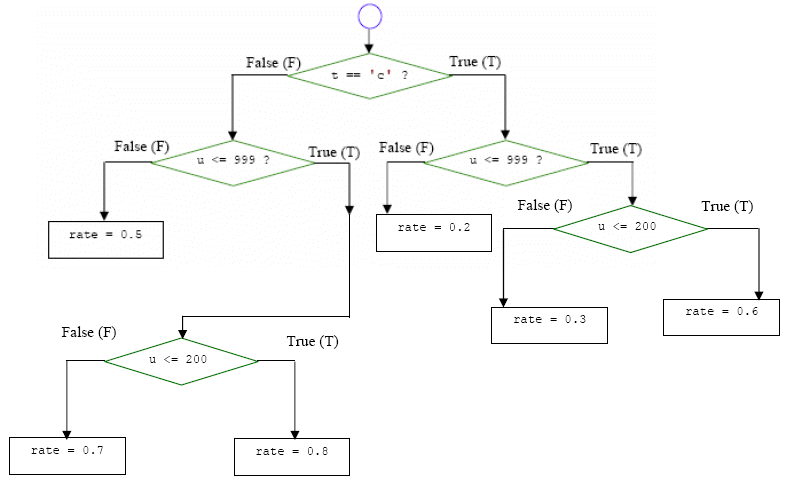
Using the provided data in the Table, complete the following flowchart to assign a proper value ofrate and then write a full working program.
Unit used (u) | Residential rate | Commercial rate | 0 < units <= 200 | 0.8 | 0.6 | 200 < units <= 999 | 0.7 | 0.3 | Above 900 | 0.5 | 0.2 | code | 'r' | 'c' | Table 2 |
| #include <stdio.h> int main(void) { double r = 0.0; int electric_unit_used = 0; char prop_type = '1'; printf("Enter the type of property, c-commercial, r- residential: "); scanf_s("%c", &prop_type, sizeof(char)); printf("Enter the electric unit used: "); scanf_s("%d", &electric_unit_used, sizeof(int)); if(prop_type == 'c') { if(electric_unit_used <= 200) { r = 0.8; printf("The rate is %.1f\n", r); } else if (electric_unit_used <= 999) { r = 0.7; printf("The rate is %.1f\n", r); } else { r = 0.5; printf("The rate is %.1f\n", r); } } if(prop_type == 'r') { if(electric_unit_used <= 200) { r = 0.6; printf("The rate is %.1f\n", r); } else if (electric_unit_used <= 999) { r = 0.3; printf("The rate is %.1f\n", r); } else { r = 0.2; printf("The rate is %.1f\n", r); } } return 0; }
|

|
| |


|
|